Bulgaria’s Parliament in traditional tussle over anniversary of Soviet invasion
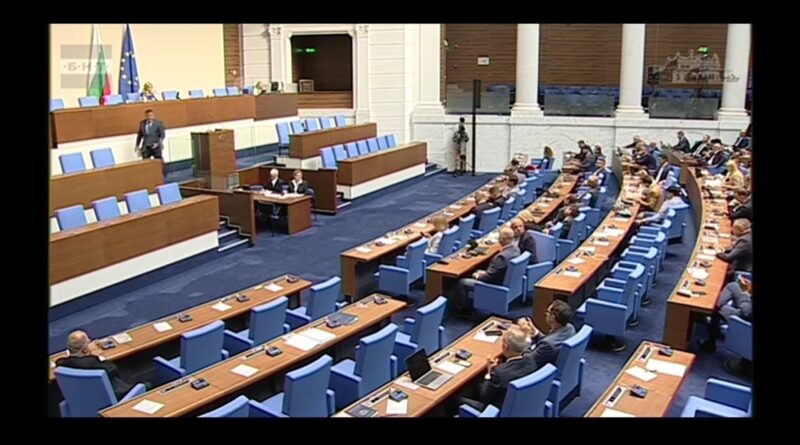
The National Assembly sitting on September 9 saw the by-now traditional tussle between pro-Western and pro-Russian MPs about the anniversary of the 1944 invasion of Bulgaria by the Soviet Union’s Red Army that resulted in decades of communist rule.
Democratic Bulgaria MP Yordan Ivanov said that on September 9 1944, the darkest period in the modern history of Bulgaria began.
Ivanov said that on September 51944, the Soviet Union declared war on Bulgaria, and on the night of September 8-9, the Konstantin Muraviev government was overthrown in a coup. A Stalinist government was established in power.
“Through the so-called People’s Court, 147 death sentences were pronounced against three regents, 67 members of parliament, 22 ministers, generals, colonels and public figures,” Ivanov said.
The communist regime took away the freedom of citizens, trampled on their human dignity and condemned the country to political and military dependence on Moscow.
Ivanov said that nearly 40 years after the collapse of the regime, the Bulgarian Socialist Party has still not condemned the bloody legacy of the Bulgarian Communist Party and has not asked for forgiveness from the victims.
He said that in 2018, the Democrats for a Strong Bulgaria (part of the Democratic Bulgaria coalition) had called on then-president Roumen Radev to convene a team of Bulgarian historians and foreign experts to be selected to prepare a comprehensive report on the history of political violence in Bulgaria. The initiative remained unanswered.
“Propaganda suggestions are easily superimposed on the living trauma in the collective memory, nostalgia is exploited and historical myths are revived. That is why, nearly 40 years after the collapse of the communist regime, the Bulgarian Prime Minister (Radev) allows himself to revive the rhetoric of the Cold War,” Ivanov said.
“History has shown clearly – without the Kremlin, Western Europe prospered, and under the Kremlin’s dependence, Eastern Europe lagged behind. We bow to the victims of the Red Terror” he said.
Kostadin Kostadinov, leader of the National Assembly’s smallest group, pro-Russian party Vuzrazhdane, said that “a series of lies” had been superimposed on the date of September 9.
Kostadinov rejected the assertion that on September 9 1944 Bulgaria’s European development was stopped.
It was “nothing like that,” he said.
Bulgaria “was one of the most developed countries in the world in 1989,” Kostadinov said, referring to the final year of communist rule in Bulgaria.
“Yes, there are those who were unjustly convicted by the People’s Court, but such was the time in all of Western Europe, not just in Eastern Europe,” he said.
We Continue the Change MP Velislav Velichkov traced Bulgaria’s history from the September 6 1885 Unification of Bulgaria and Eastern Rumelia to the 1944 invasion.
“September 9 (1886) was the date on which Prince Alexander Battenberg, much more Bulgarian than many Bulgarians at the time, risked his dethronement and a year later he was effectively dethroned in order to unite the state he represented,” Velichkov said.
On September 9 1944, this independence was brutally trampled, he said.
Velichkov said that thousands of Bulgarian citizens were killed without trial or sentence, which he said was state terrorism ordered by the Soviet Union and its agents in Bulgaria.
“As for the People’s Court – this was not a court, but a communist and partisan tribunal that had to hand out retribution ordered by the Soviet Union, not justice,” he said.