
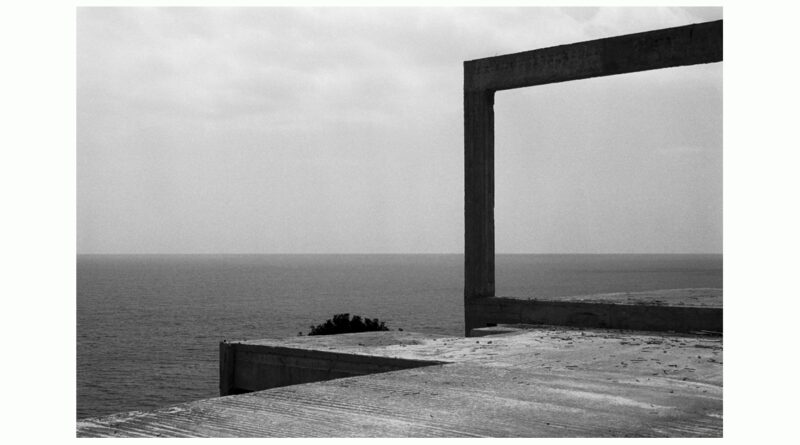
‘Wanderings About History. The Photography of Ulrich Wüst’ exhibition opens at Sofia City Art Gallery on September 10
An exhibition entitled “Wanderings About History. The Photography of Ulrich Wüst ” opens at Sofia City Art Gallery on September 10 and continues until November 22 2026.
For the fourth time, the Goethe-Institut Bulgaria and the Sofia City Art Gallery are spotlighting contemporary German photography with the work of Wüst, following exhibitions featuring Sibylle Bergemann (2022), Barbara Klemm (2023), and Helga Paris (2024).
The exhibition features more than 120 photographs, primarily black-and-white archival pigment prints.
Wüst’s professional experience as an urban planner and photo editor has shaped his distinctive photographic approach—analytical, precise, and rigorously composed—with his interest focused not so much on historical ruins or traces of war as on the absurdities and contradictions arising from urban planning —the demolition of existing architecture, indiscriminate construction, and the critical transformation of the urban environment.
Through his neutral, mostly black-and-white images, he constructs a distinctive visual critique of architecture that lacks a direct ideological position.
Ulrich Wüst’s oeuvre first attracted attention in the 1980s, above all on account of his many Cityscapes, taken in several towns around the former East Germany, the “German Democratic Republic”.
These images show scarring from the Second World War and an unchecked decay of historical built fabric. At the centre of his photographic interest, however, were those absurdities in urban situations that derive as much from a lack of attention or cluelessness as from wanton destruction or uncontrolled development.
With his camera, Wüst evolved his own, very visual way of critiquing architecture. It has lost none of its poignancy today, especially as his argument is never ideological but borne along by a sense of phenomena that offers as much scope for subtle humour as for irony.
A wider international audience discovered Wüst’s photography when he was invited to exhibit at documenta 14 in Kassel in 2017.
Wüst’s photographic oeuvre, which explores Eastern Germany in the broader sense, is not confined to the sunken GDR. It might be described as a pictorial archaeology of our present day. These pictures reveal the finds from his “excavations” and are at the same time tools of their conservation. Wüst has an infallible feel for the graphic quality of everyday situations, objects and materials, but also for the deeper layers of significance associated with found images.
Examples are the enlarged details from East German press products that demonstrate a manipulative use of photography.
Wüst’s photography can be contemplated from different perspectives. While the observations captured here are essentially rooted in Germany’s division and its mending, at the same time they always relate to universal phenomena of social change and its material manifestations.
The seemingly terse images, extremely precise in their composition, are the fruits of lengthy visual wanderings through present sites of recent history.
During the exhibition, visitors will have the opportunity to purchase the accompanying catalogue, published by Spector Books.