
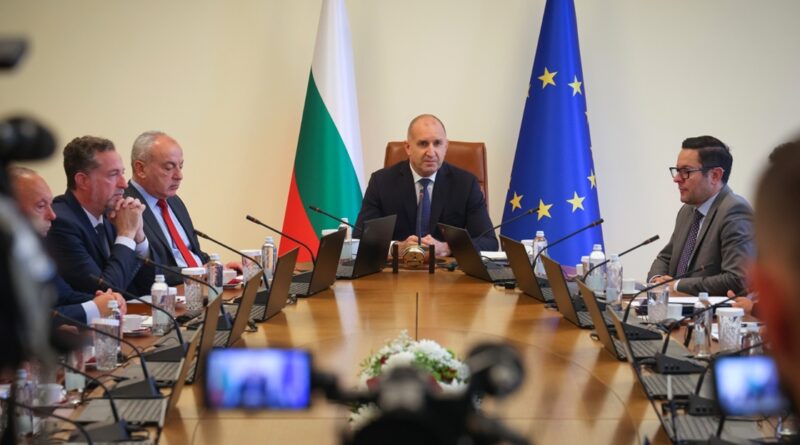
Alpha Research: Radev’s government has 42% approval, 33% disapproval ratings
The approval rating of Prime Minister Roumen Radev’s government is 42 per cent, with a 33 per cent disapproval rating and 25 per cent neutral, according to a poll by Alpha Research, the results of which were released on July 30.
The poll was done in context of Radev’s government, which took office on May 8, soon to have been in power for 100 days.
Bulgarians’ most serious concerns remain the rise in prices, corruption, health care and road safety.
These are the topics on which there is the greatest discrepancy between the significance of the problems and the public assessment of the effectiveness of the measures taken by the government.
“The government’s Achilles heel is the specific policies to solve people’s everyday problems,” Alpha Research’s Boryana Dimitrova told bTV.
Thirty-two per cent of citizens believe that the Radev cabinet’s management is competent and effective. But 33 per cent find it insufficiently prepared, and 25 per cent responded that it is not coping. Ten per cent could not say.
Dimitova said that Radev’s high personal rating currently compensates for some of the criticism of the Cabinet’s work.
“After the first 100 days, people will increasingly evaluate the government based on concrete results,” Dimitrova said.
Party differences are clear. Supporters of Radev’s Progressive Bulgaria party are the only group with predominantly positive assessments of the Cabinet.
Supporters of Delyan Peevski’s Movement for Rights and Freedoms (MRF) are polarised, and negative assessments dominate among the remaining party electorates.
Radev’s starting rating as Prime Minister is 48 per cent positive, 31 per cent negative, and 21 per cent neutral.
With 47.8 per cent approval and 31.3 per cent disapproval, Radev is the only party leader with a positive rating and a major rating asset for both the government and his party.
Were Bulgaria to hold parliamentary elections now, Progressive Bulgaria would get 41.6 per cent among those who would vote, with Boiko Borissov’s GERB-UDF trailing a distant second at 13.1 per cent.
We Continue the Change has 6.6 per cent, Democratic Bulgaria 6.1 per cent, the MRF 6.2 per cent and pro-Russian party Vuzrazhdane four per cent, precisely on the threshold for winning a share of seats in the National Assembly.
Alpha Research said that the main conclusion of the poll, shortly before the government turns 100 days old, is that the ruling party has an electoral lead and relatively favourable institutional and personal assessments.
However, public support can be defined as “given conditionally”, since it is not backed by the belief that adequate policies are being proposed to solve the country’s key problems.
The fragmentation of the opposition prevents it from gaining greater visibility and public weight, which makes it easier for the ruling party for the time being. The political challenge for relations along the “ruling party – opposition” axis will be the presidential vote, the polling agency said.
Six months after taking over from Radev as head of state, President Iliyana Yotova has the highest political rating in the country – 50 per cent approval, 29 per cent disapproval and 21 per cent neutral assessments.
She has won the trust of broad social strata, the core of which are the sympathizers of Progressive Bulgaria and the Bulgarian Socialist Party, Alpha Research said.
The stated support gives a strong start to her candidacy for president, announced after the end of the survey. In this role, Yotova is already entering a new electoral dynamic, which will depend heavily on the future opponents in the race and the political configurations behind them, Alpha Research said.
After more than 15 years of dramatic erosion in trust in the legislative branch, ranging between seven and 18 per cent, the current 52nd National Assembly started with 20 per cent support.
Thirty-six per cent are critical of the first months of the legislators’ activities, while 44 per cent have no opinion.
The assessment of the work of the Speaker of the National Assembly Michaela Dotsova is similar – 19 percent approval, 23 percent disapproval, and a high share of 58 percent neutral attitude, due to her still weak recognition.
The poll was done from July 17 to 23 2026 and is part of the regular polling by Alpha Research. It is published on the agency’s website and was done using its own funds. The poll was done among 1000 adult citizens from all over the country. A stratified two-stage sample with a quota according to the main socio-demographic characteristics was used. The information was collected through a direct standardised interview with tablets at the homes of the respondents.
(Photo: government.bg)