

Eurostat: Since 1964, marriage rate in EU has more than halved, divorce rate has doubled
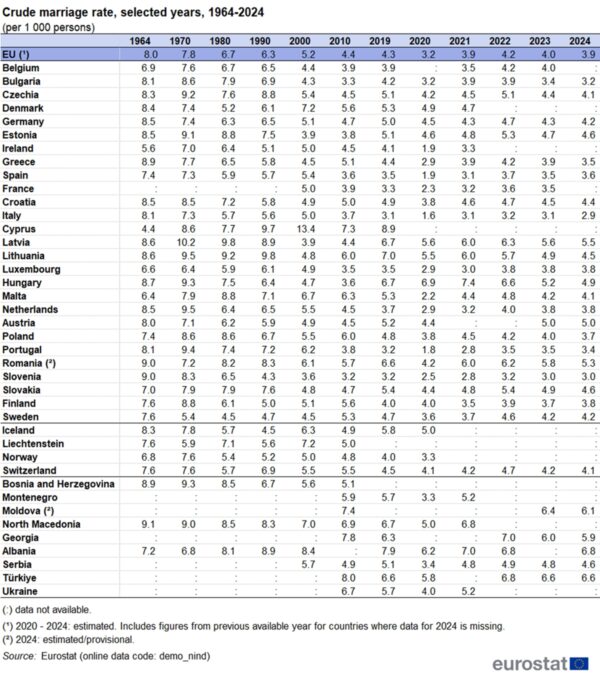
Since 1964 – the first year for which data are available – the crude marriage rate in the European Union has declined by more than 50 per cent in relative terms, EU statistics agency Eurostat said on March 20, posting data as of 2024.
An estimated 1.7 million marriages and an estimated 0.7 million divorces took place in the EU in 2024, Eurostat said.
These figures may be expressed as 3.9 marriages for every 1000 persons (in other words the crude marriage rate) and 1.6 divorces for every 1000 persons (in other words the crude divorce rate).
From 1964 to 2024, the crude marriage rate in the EU dropped from eight per 1000 persons to 3.9 per 1000.
The downward trend was interrupted by some intermediate peaks in 1989 (6.4 per 1000 persons), 2000 (5.2), 2007 (5.0) and 2018 (4.5).
Eurostat said that the substantial decrease observed between 2019 (4.3 per 1000 persons) and 2020 (3.2) in the crude marriage rate could be interpreted as an effect of the Covid-19 pandemic, representing a fall of almost 25 per cent.
Since then, a slight increase can be observed in the crude marriage rate, estimated at 3.9 in 2024.
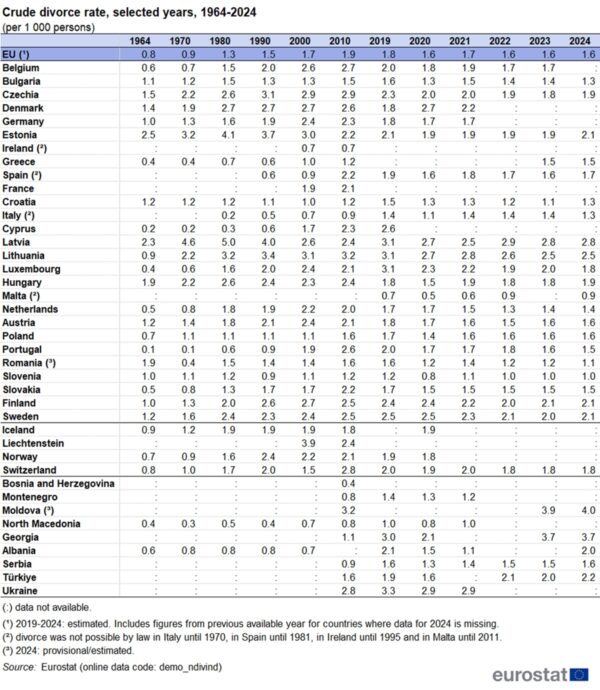
Over the same extended period, the crude divorce rate has essentially doubled, increasing from 0.8 per 1000 persons in 1964 to 1.6 in 2024.
The divorce rate peaked in 2006 (2.1 per 1000 persons) and has been declining slightly since then.
Eurostat said that part of this increase may be due to the fact that divorce was legalised in several EU countries during this period (for example, in Italy, Spain, Ireland and Malta).
The beginning of the Covid-19 pandemic seems to have impacted the divorce rate as well, as can be seen by the slight drop taking place between 2019 and 2020, the statistics agency said.
Nevertheless, the decrease in the crude divorce rate was far less pronounced (about 10 per cent) than the one observed for the crude marriage rate.
In 2024, the highest crude marriage rates were in Latvia (5.5 marriages per 1000 persons), Romania (5.3) and Austria (5.0).
The lowest crude marriage rates were reported in Italy (2.9 marriages per 1000 persons), Slovenia (3.0) and Bulgaria (3.2).
Between 2023 and 2024 the indicator decreased in 15 of the EU countries for which data are available, it was constant in 5, and increased in 2 (Spain and Finland).
For divorces, in 2024 the lowest crude rates in the EU were registered in Malta (0.9 divorces per 1000 persons), Slovenia (1.0) and Romania (1.1).
By contrast, divorce rates were highest in Latvia (2.8 divorces per 1000 persons), Lithuania (2.5) and Estonia, Finland and Sweden (each 2.1).
Between 2023 and 2024 the indicator decreased in five of the EU countries for which data are available (Bulgaria, Italy, Luxembourg, Portugal and Romania), was constant in nine EU countries and increased in the six EU countries (Czechia, Estonia, Spain, Croatia, Hungary and Sweden).
The proportion of live births outside marriage has shown an increasing trend in the past decades, more than doubling since 1993 (17.7 per cent) when these data were first available in the EU.
In 2024, this proportion was estimated at 41.1 per cent, meaning that 58.9 per cent of children were born inside marriage.
This share reflects changes in patterns of family formation alongside the more traditional pattern where children were born within marriage.
Extramarital births occur in non-marital relationships, among cohabiting couples, to lone parents and in registered partnerships.
Extramarital births outnumbered births inside marriage in six of the EU countries for which data are available, notably Bulgaria (where 61.9 per cent of births occurred outside marriage), France (59.7 per cent), Portugal (59.2 per cent), Sweden (57.1 per cent), Slovenia (55.5 per cent) and Estonia (50.7 per cent).
Greece was at the other end of the spectrum where more than 90 per cent of births occurred within marriage.