
PM Radev, Finance Ministry, try to shift blame as Bulgaria faces possible fine over excessive deficit
Prime Minister Roumen Radev and his Finance Ministry have tried to shift blame on to previous governments as Bulgaria faces a possible fine because of its inaction to address the excessive deficit.
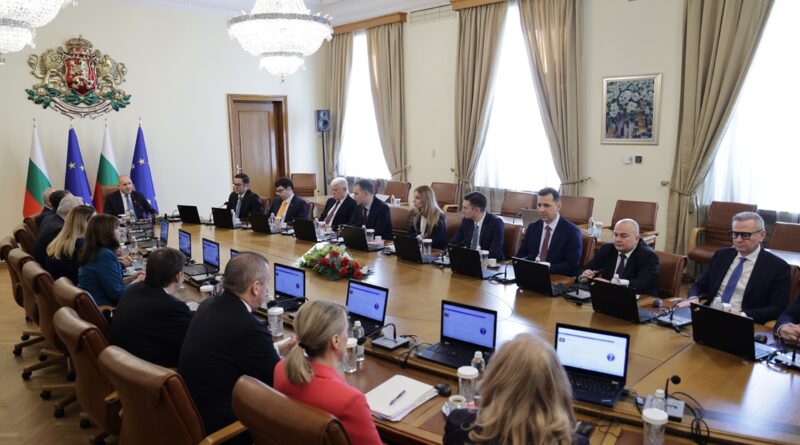
Radev’s comments at a November 25 regular meeting of the Cabinet came nine days after he told his ministers to stop blaming previous governments.
The Bulgarian government information service quoted Radev as telling the November 25 meeting: “Yesterday, the European Commission slapped a resounding slap on everyone who over the years spent recklessly without attracting investments, who borrowed without developing the economy, lied about the real deficit to get us into the euro zone, and led the finances to an excessive deficit and catastrophe”.
According to Radev, the European Commission’s good forecast for next year “is a clear confirmation that the course taken by the government to restore state finances is correct”.
“So we will not fulfill the nihilistic dreams of the opposition to stop our European funding and payments under the RRP (Recovery and Resilience Plan),” Radev said.
Radev said that the government “will continue with the reforms and the elimination of inherited inefficient and corrupt practices in public enterprises”.
“Since the beginning of the year, foreign direct investment has increased by more than 100 per cent, and this percentage is increasing even more,” he said (In fact, going by Bulgarian National Bank data, as reported by The Sofia Globe, the increase in FDI in January – September 2026 is about 66 per cent on an annual basis).
A statement by the Finance Ministry on November 24, when the European Commission announced its recommendation that Bulgaria should be fined, offered similar arguments.
“Today’s assessment by the European Commission (EC)—part of the European Semester’s Autumn Package—points to a significant deviation from the recommended trajectory for net expenditure for 2026, as well as the risk of sanctions for failing to comply with the Council’s recommendation of July 10 2026,” the Finance Ministry said.
“This situation is a direct consequence of accumulated systemic problems and the political crisis of recent years—issues for which all political forces bear shared responsibility,” the ministry said.
According to the Finance Ministry “it is important to clarify that such a sanction has no bearing on the fifth payment under the Recovery and Resilience Plan, nor is it expected to block funds from European sources”.
“The government will continue to restore the state’s financial stability, while strictly safeguarding key social commitments, support for vulnerable groups, and predictability for citizens and public services,” the ministry said.
“The responsibility now lies with the National Assembly—we expect all political parties to demonstrate statesmanship during the adoption and implementation of the 2027 Budget, so that the flawed practices leading to EU sanctions may be consigned to the past once and for all,” it said.
Of the eight governments that Bulgaria had between January 2017 and January 2026, while Radev was president, he appointed four as interim administrations. Of those four, one was in office for 308 days, from 2022 to 2023. It was headed by Gulub Donev, who currently is Radev’s Finance Minister.
(Photo: government.bg)


