
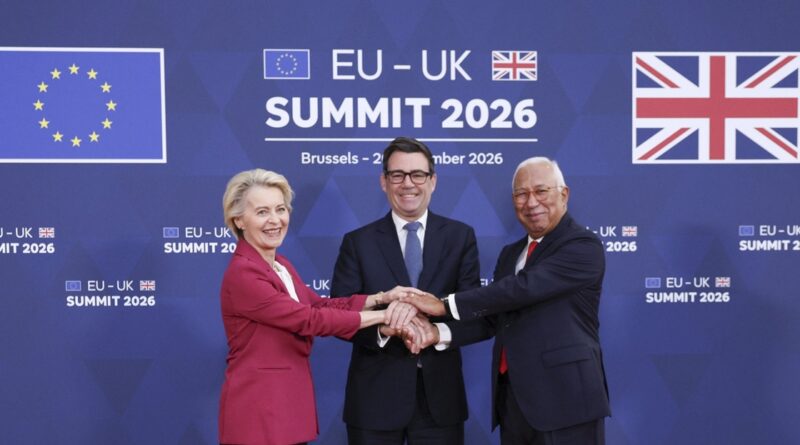
EU, UK in ‘landmark deal’ on food exports, youth mobility and carbon emissions
The European Union – United Kingdom summit on November 20 produced a “landmark deal” on food exports, youth mobility and carbon emissions, but negotiations on university student fees – with the EU wanting its students to pay the same as British students in the UK – are to continue.
The joint statement, announced at a joint news conference by European Commission President António Costa, European Commission President Ursula von der Leyen and UK Prime Minister Andy Burnham, is part of efforts to “reset” the relationship between the bloc and Britain, 10 years after Brexit.
Costa said: “A strong partnership between the European Union and the United Kingdom is a strategic investment in Europe’s security. But it is also an investment in our shared prosperity, in innovation, competitiveness and resilience. Because there can be no strong defence without a stronger economy”.
“There is much more we can achieve together. We are not competing against each other, we are building win-win solutions together,” Costa said.
The European Union is a union of sovereign nations which respects sovereign natures, he said: “We respected the sovereign decision taken by the British people in 2016”.
“And I recall the words of the European Council after the referendum. We regret but we respect. And we will equally respect whatever decision the United Kingdom takes about the future of its long-term relationship with the European Union,” he said.
“Of course, we follow with great interest the debate you have relaunched about our common future. And as you know, we remain open to have the closest possible relationship between the European Union and the United Kingdom.”
Von der Leyen said: “We know the world around us is changing fast, making a closer and stronger partnership between the European Union and the UK the more important. And indeed, the spirit of our cooperation is win-win. Our economies are deeply connected.”
“Last year, we agreed on an ambitious agenda, and today we are delivering. First, we are bringing our people closer together. From next year on, the United Kingdom will once again take part in Erasmus+,” Von der Leyen said.
She said that negotiations had been concluded on a youth experience scheme. “It will allow 100 000 young people from each side to spend up to three years in each other’s countries. To work, to study, to volunteer, to simply travel.”
Von der Leyen said that negotiations had been concluded on an agreement on food and other agricultural products: “This is a big success. It is a two-way street”.
“For our businesses on both sides of the channel, it means easier trade and lower costs. And for our consumers, it means more choice and more affordable food, so lowering the living costs. We have also concluded negotiations to link our carbon markets.”
“The agreement will cut emissions, and it will generate investments in cleaner industries. It will help us advance our shared climate goals. Work also continues towards the United Kingdom’s participation in our electricity market,” Von der Leyen said.
Burnham said: “We’re 10 years on from Brexit, but I think we can all confidently say this is a good day for Britain, and this is a good day for Europe”.
“The agreement that we’ve reached together is a win-win. And it is in tune with public opinion in the UK. People can see the status quo isn’t working,” Burnham said.
“It’s not good enough for Britain. Three quarters of people say that they favour closer ties with Europe, according to the most recent polls. And that is because we’ve had a decade of drift, too much division, low growth in the economy, and higher prices in the shops,” he said.
“They want a better deal than the hard Brexit we ended up with. And today, together, we have delivered that better deal. As I say, it will be good for people in Britain, and good for people in Europe,” Burnham said.
“It directly addresses the biggest challenges of our times, and the biggest worries that people have. The cost of food. The cost of energy. The lack of growth in the economy, and the cost of doing business. The levels of illegal immigration. And the challenges facing our young people.”
Ffor people who are worried about the cost of the weekly shop, this deal will help, he said.
“By cutting the costs of exporting, it will help relieve pressure. At the moment, it can cost up to £1400 to export a single shipment of salmon. And obviously, that’s too high, and it will bring costs for business down.”
The deal would bring the cost of food down “and nd it opens up the possibility of lower electricity costs”.
There are so many businesses out there who are worried about the cost of doing business, Burnham said.
Burnham said that Chancellor of the Exchequer John Healey had “confirmed today that the UK Treasury has said that the deal struck here will add up to 0.5 per cent to UK GDP”.
“That is a £17 billion boost to the British economy. It is the single biggest growth measure that we could take in this Parliament,” Burnham said.
Brexit did take away opportunity from our young people, he said.
“And I can say to the young people of Britain, you will have, as a result of this deal, a new freedom. For anyone under 31, you will have much greater ease and ability to travel to any of the wonderful 27 member states of the European Union to live, to work, to study,” Burnham said.
“And that is such a positive note that we’ve been able to strike between ourselves so that the next generation can feel finally that people in our positions are directly doing something to recognise that they need more help and that they need more opportunity in their lives.”
Burnham said that a bill would be introduced in the British Parliament next week to implement this aspect of the deal.
(Photo: Council of the EU)


