In Brussels, Bulgarian PM seeks EU support for moratorium to stop attacks on civilian ships in Black Sea
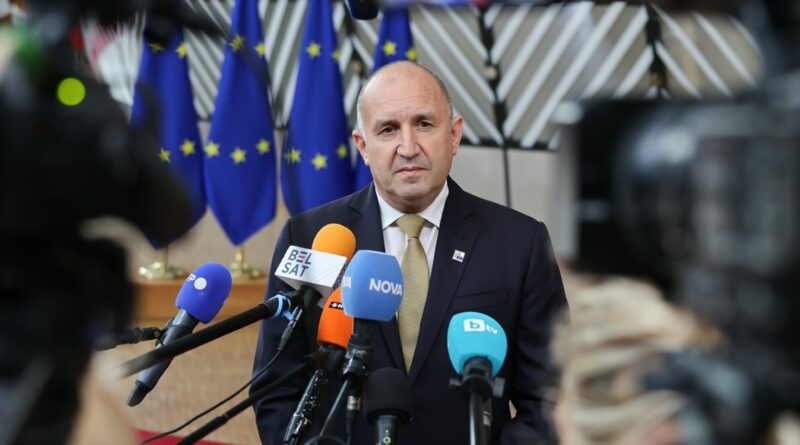
I expect solidarity from all our European partners so that the moratorium we propose to stop attacks on civilian ships in the Black Sea is adopted, Bulgarian Prime Minister Roumen Radev said in Brussels on October 15 ahead of the start of a European Council meeting.
This unacceptable aggression must stop, Radev said.
A total of four ships have come under attack in Bulgaria’s exclusive economic zone in the Black Sea, in incidents on October 6 and 13, with two sunk and several lives lost.
Radev told reporters at the EU headquarters in Brussels that the Black Sea is not just a security zone, but also an extremely important strategic corridor for the supply of food, fertilisers and energy resources.
“Millions of people depend on these supplies, especially in vulnerable areas such as Africa and the Middle East,” he said.
Radev said that the idea of a moratorium was discussed last week during a video conference with a number of European leaders and European Commission President Ursula von der Leyen, “and today there is already a call to stop attacks on civilian ships in the draft Council conclusions”.
He emphasised the importance of cooperation between Bulgaria, Romania and Türkiye regarding security in the Black Sea.
In response to a reporter’s question about the Coalition of the Willing, Radev said: “We are for any coalition that is for a quick end to this conflict through the power of diplomacy.”
He said that Bulgaria has not severed its diplomatic ties with Russia, and he had recently held a conversation with Russian ambassador and confirmed his position that it is necessary to expand diplomatic channels of communication with specific measures and proposals.
Radev for the first time named “Russia’s war against Ukraine” as the source of the escalation and risk in the Black Sea.
Until now, he has avoided naming Russia as the aggressor.
But in spite of the change in language, Radev remains cautious about responsibility for the strikes on merchant ships and continues to push for an end to the war through diplomacy.
“We state very clearly that the escalation in this war and the risk come from Russia’s war against Ukraine. And this is a fact,” Radev said.
In response to a question about how Germany can have a clear position on the origin of the drones, the prime minister said that he “does not base his positions on hypotheses.”
“If Germany has any evidence, I will ask Chancellor Merz to provide it to us today . But I say again: we do not base our accusations on hypotheses,” he said.
According to Radev, at the moment there is still no definitive evidence of the origin of the drones that carried out the
strikes in the Black Sea and the investigation is ongoing.
Today, the Chelsea 3 ship, damaged in the October 13 attacks, is expected to be towed to the Bourgas port, where there will be an opportunity for the most thorough and detailed examination.
“We have a hypothesis – that it is logical that the attacks come from Russia, because there is no way Ukraine can attack its own ships and its own crews. And the results are in favour of Russia.
“However, there is no definitive evidence at the moment. We do not base our accusations on hypotheses. When we talk about accusations against a given country, we want to have solid, clear evidence,” Radev said.
“I hope today, when the Chelsea-3 ship is towed to the Bourgas port, we will also find remains of drones. Then we will be much clearer in our accusations,” Radev said.
Regarding the new Multiannual Financial Framework, he said that there was a need to preserve the most important policies, such as cohesion and agricultural policies. “Of course, Bulgaria supports all efforts to increase our competitiveness and to increase the EU’s defence capabilities, but they must be very well specified,” he said.
He said that one of the biggest problems of the EU is fuel prices.
Over the past two decades, Europe has protected a number of its refineries, and now it is extremely dependent and is already looking for supplies of finished fuels, diesel, especially aviation fuel, he said.
“So we accept the Lukoil refinery as a very important asset not only for Bulgaria, but for the entire EU,” he said, emphasising that the refinery in Bulgaria is one of the largest and one of the most modern in Europe.
“The future of Lukoil is important for Europe and we must have a clear, not only national, but also European voice when this future is decided, and for now it is decided outside the EU, and for an asset that is strategically important for the EU,” Radev said.
“So I am pleased that this issue is included today in the document that we will discuss, and I hope that we will reach some rational solution and strategic approach to these issues,” he said.
Radev said that the dialogue between the European Union and the Gulf states, especially Saudi Arabia was important. He emphasised the importance of the railway corridor from Saudi Arabia through Syria, Türkiye and Bulgaria to Europe in connection with the supply of fuels from this region.
“We have a strong interest in ensuring more secure routes and diversifying the routes for the supply of energy resources,” he said,
Asked by a journalist about Brexit and whether he would welcome the United Kingdom’s return to the European Union, Radev said yes and added that it is important that the United Kingdom has drawn its own conclusions about what leaving the EU means.
“We want to see a stronger and larger European Union. I believe that the United Kingdom is one of the most important pillars of security on our continent,” Radev said.
Asked whether he supports the US decision to lift sanctions against Russian fuels, Radev said: “Do you know what our problem is right now in Europe? High fuel prices. We appreciate every step that guarantees a reduction in fuel prices and our competitiveness”.
(Photo: government.bg)