
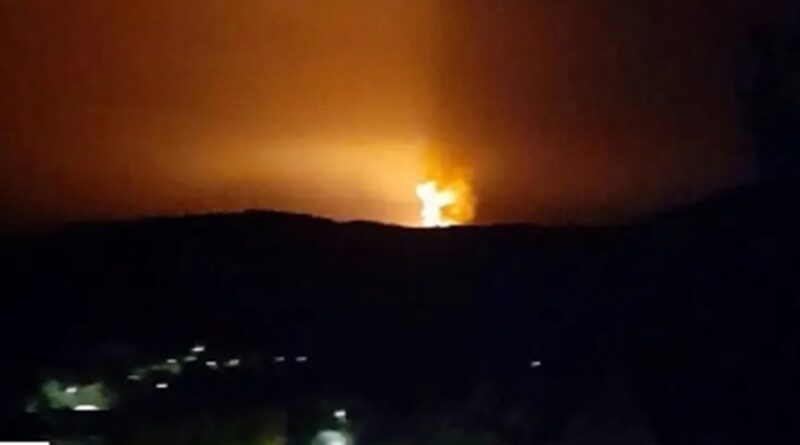
Emco: Blast at ammo deport in Bulgaria was sabotage, state is failing to do its job
The explosions at an Emco ammunition deport on the night of September 11 near the village of Gorni Varpishta in the Dryanovo region were sabotage and the state authorities are failing to do their job competently, the arms manufacturer and trader said in a media statement on September 12.
Emco said that such destruction of defence sector warehouses had become an everyday occurrence since 2011.
“In spite of all the efforts of defence companies to encourage the authorities to pay serious attention to this problem, as is the case in all normal countries, there is no result,” Emco said.
None of the investigations into more than 10 similar incidents across all leading companies in the industry have been concluded, the company said.
There can be no other explanation for this than the inability of the state bodies, “which we appoint and support as taxpayers”, to do their job competently, Emco said.
It said that “another explanation would be the complicity of representatives of the authorities themselves in criminal activity, which we do not even want to think about.”
The company said that “the indifferent attitude of state representatives towards these sabotages encourages their perpetrators and sponsors, and they continue their activities with impunity”.
Emco called on Bulgaria’s Parliament to analyse the causes of these vulnerabilities in Bulgaria and to take steps to eliminate them.
It ruled out human error as the cause of what happened on the night of September 11 and said that such incidents are occurring with increasing intensity throughout Europe, and Bulgaria is “the EU and Nato country most affected by such actions,” so it must join in joint efforts to prevent such attacks.
Emco said that the incident at its warehouse on September 11 was no exception to the series of sabotage against the Bulgarian defence industry.
“The purpose of the particular warehouse is such that it completely excludes human error as the cause of its destruction,” it said.
“This warehouse has not been used for months, and no company employees or other persons outside the established order have entered it.”
Emco said that the warehouse has been subject to periodic inspections by the Ministry of Interior authorities, seven times since the beginning of the year, the most recent one being 20 days ago.
“Full compliance with regulatory requirements has always been found, there were no notes or prescriptions from the inspectors from the Ministry of Interior. The above is certified by protocols prepared by the inspectors themselves, as required by law.”
Earlier on September 12, on visiting the village, Bulgaria’s Interior Minister Ivan Demerdzhiev hinted at shifting blame on to Emco, telling reporters: “There is a neglect of the conditions under which explosives and ammunition are stored. There is also a neglect of the method of security.”
“We will inspect every single warehouse in the country,” Demerdzhiev said.
“We will issue the necessary instructions. Since the owners cannot take measures, the state will step in and do what is necessary. We see a lot of shortcomings, not only in this enterprise,” he said.
“We do not rule out external interference, but when you have neglected the conditions under which explosives are stored and security, then one does not exclude the other,” Demerdzhiev said.
“Companies that do this must do it as responsibly as possible. And if there is external interference, it is our responsibility – to establish it and collect the necessary evidence. Obviously, the level of security must be raised at all sites, not only because of the situation in Bulgaria, but also around the world,” he said.
Bulgaria’s pro-Western opposition parties see in the incidents at the arms plants a link to Russia’s campaign of sabotage in Europe. Emco production is used in Ukraine to defend the country against Russia’s illegal invasion.
President Iliana Yotova told reporters on September 12 that she is “considering” convening the Consultative Council on National Security after the recent explosions at the Emco arms plant warehouses in Bulgaria.
Yotova, who took office as head of state in January 2026 and is seeking election as president in autumn 2026, has not heeded opposition calls for the council to be convened, even though by law the Consultative Council on National Security should meet at least every three months.
Bulgarian presidential candidate Andrei Gyurov, who is standing in the elections on a ticket backed by pro-Western groups Democratic Bulgaria and We Continue the Change, said on September 12 that the explosion at the Emco ammunition depot is not a pre-election ploy, it is a test of statehood.
There is proven hostile interest in Bulgaria’s arms infrastructure, Gyurov said.
“Therefore, the public has the right to ask: who is guarding the state?” he said.
“That is why I have publicly called today for the convening of the Consultative Council on National Security; it is time for the institutions to provide clear answers and assume responsibility for the state’s security,” Gyurov said.
(Screenshot via BNT)