European Commission puts forward 21st sanctions package against Russia over war on Ukraine
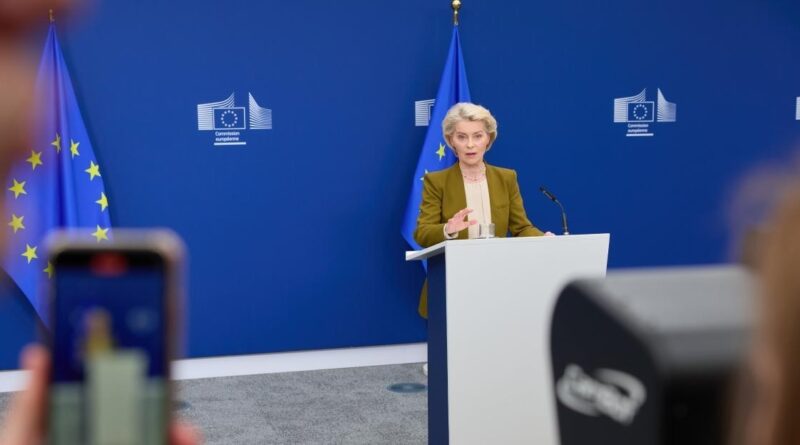
European Commission (EC) President Ursula von der Leyen announced on June 9 the proposed 21st package of sanctions against Russia over its war on Ukraine.
Von der Leyen said that the sanctions package focuses on sectors with the highest impact – energy, financial services and crypto, trade – including fisheries, for the first time – “and we are banning the entry of former Russian combatants into the European Union”.
On energy, she said that the conflict in the Middle East and disruptions to global energy supply chains have eased some pressure on Russia.
“So, the objective of our package could not be clearer. We want to maintain the full intensity of our sanctions. And the way to do this is to ensure that Russia’s profits from oil sales remain contained,” Von der Leyen said.
“Our oil price cap has a built-in adjustment mechanism to follow the market,” she said.
It was not made for market shocks like the one caused by the closure of the Strait in Hormuz, Von der Leyen said.
“So we propose to simply pause the adjustment until January next year.”
She said that this would give oil markets time to stabilise while preserving pressure on Russia’s revenues.
“At the same time, we will continue targeting the shadow fleet. Today, we propose listing 30 more vessels on top of the 632 already sanctioned,” she said.
“For the first time, we are also targeting vessels that assist the shadow fleet – providing bunkering and other services for example. And we propose targeting critical infrastructure, such as ports, airports, refineries trading or processing Russian oil. Finally, we propose restricting the sale of LNG tankers to Russia, just as we already did for oil tankers.”
On financial and crypto restrictions, Von der Leyen said: “We are expanding our transaction bans to 31 more Russian banks. And to 20 banks, crypto firms or platforms and oil traders in third countries, ones that have been servicing sanctioned Russian entities and individuals or circumventing our measures”.
“For the first time, we will introduce the possibility of a full third-country ban for crypto-asset services. It will act as a strong deterrent for the countries hosting platforms that help Russia evade our sanctions.”
On trade, Von der Leyen said that the EC was putting forward new export restrictions on items and technologies used by Russia’s military industry.
“For example, we are targeting more metals and alloys used in the aerospace and defence sectors,” she said.
“For drones, we propose new export bans on ground support equipment, and jamming and launch systems, among others.”
The EC is also proposing new import bans on a number of goods worth 60 million euro, such as – for example – certain metals, metal ores or car parts..
“And finally, we are addressing one of the last major unsanctioned sectors: fisheries. We propose substantial restrictions on imports on some fish products, and a complete ban on others, including cod. And we will be aligning trade restrictions for Belarus. So it cannot serve as a backdoor for Russian trade,” Von der Leyen said.
(Photo: EC Audiovisual Service)