
European economy commissioner on ME crisis: It is clear that we are at risk of a stagflationary shock
The full impact on the European economy from the Middle East crisis will depend on the duration, scope and intensity of the conflict “but it is clear that we are at risk of a stagflationary shock,” European Economy Commissioner Valdis Dombrovskis said after a March 27 meeting of the Eurogroup.
“It is now clear that the scale, severity and impact of the war has increased since we last met a little over two weeks ago,” Dombrovskis said.
The Strait of Hormuz has been weaponised and energy infrastructure continues to be targeted. As a result, energy prices have surged, he said.
Dombrovskis said that Brent crude had been trading consistently above $100 per barrel for two weeks now.
“Naturally, the full impact on the European economy will depend on the duration, scope and intensity of the conflict. And for now, the outlook is clouded by profound uncertainty.
“But it is clear that we are at risk of a stagflationary shock. That is to say, a situation where slower growth coincides with higher inflation,” Dombrovskis said.
This is the case even if the disruptions to energy supplies were to be relatively short-lived, he said.
“In such a scenario, our analysis suggests that EU growth in 2026 could be around 0.4 percentage points lower than projected in our Autumn Economic Forecast. And inflation could be up to one percentage point higher,” Dombrovskis said.
If disruptions prove more substantial and longer-lasting, the negative consequences for growth would be even greater, he said.
Growth could be up to 0.6 percentage points lower in both 2026 and 2027, Dombrovskis said .
“Moreover, other channels could further amplify the negative economic impact of the crisis I just outlined,” he said.
“To reiterate once again, this is not a forecast, this is a scenario analysis to give an idea of the scale of the potential impact.”
He said that at last week’s meeting of the European Council, EU leaders called on the European Commission to present a toolbox of targeted temporary measures to address higher energy prices.
Dombrovskis said that the Commission will present proposals to mandate lower tax rates on electricity, and to make sure that electricity is taxed less than fossil fuels, improve the productivity of grid infrastructure, and modernise the Emissions Trading System, including by updating the benchmarks for free allocations and increasing the firepower of the Market Stability Reserve to reduce price volatility.
The Commission also stands ready to work closely with EU member states to design policy measures at national level to mitigate the impact of higher energy prices, Dombrovskis said.
“We had a good discussion on this today.”
Any effective national policy response to protect our economy and people must align with certain key principles, Dombrovskis said.
These include the need to be targeted, temporary, not increase aggregate demand for oil and gas and coherent with the need to continue decarbonising our energy system.
“Of course, policy responses can have serious fiscal implications,” Dombrovskis said.
“And our room to manoeuvre here is more limited than before given previous shocks and the urgent need for additional defence spending.
“However, our new fiscal framework includes several built-in features designed to help cushion the economy against adverse developments such as those we are currently facing,” he said.
He said that the new framework is centred on a net expenditure benchmark so that revenue shortfalls resulting from any economic slowdown do not need to be offset, increases in interest spending are not counted in the benchmark, and also the cyclical component of spending on unemployment benefits is excluded from the benchmark.
“Our first priority now must be to put in place a coherent set of policy measures that address the spikes in the prices of imported fossil fuels and that are consistent with our goal to reduce reliance on such fuels,” Dombrovskis said.
“Finally, given the global nature of this shock, we are also coordinating closely with our international partners,” he said, adding that he would participate in the joint G7 Finance and Energy Ministerial meeting on March 30 “to discuss this global impact and our policy responses”.
As The Sofia Globe reported earlier, Eurogroup president Kyriakos Pierrakakis said that measures taken during this period should be targeted, fair, and effective, with priority given to the most vulnerable households and businesses.
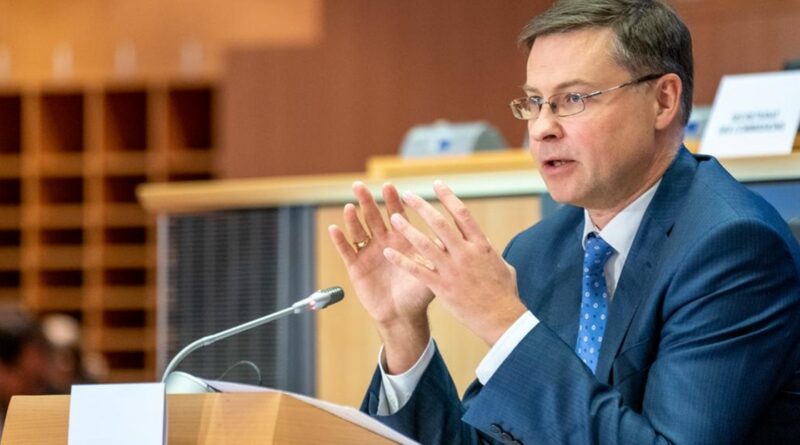
(Archive photo: European Parliament)


