VDL: Going back to Russian fossil fuels would be strategic blunder
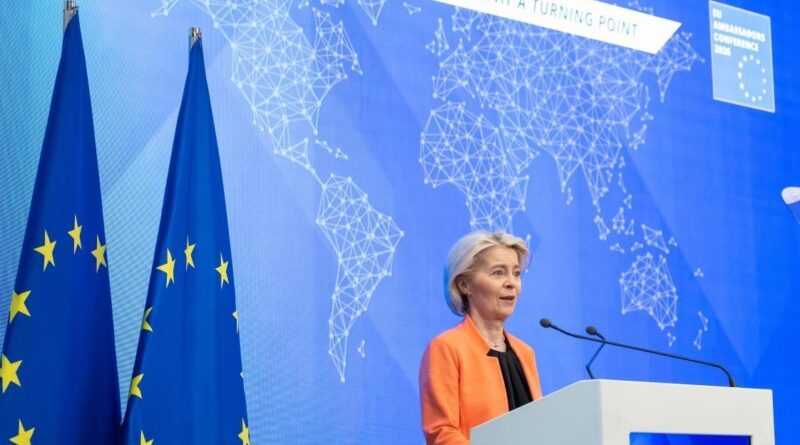
The European Union going back to Russian fossil fuels would be a strategic blunder, European Commission President Ursula von der Leyen told the European Parliament on March 11.
Von der Leyen was speaking in a European Parliament plenary debate in preparation of the European Council meeting of March 19 and 20 and on the US-Israel military operations against the Iranian regime, its consequences and the need to support the people of Iran.
“We are already seeing the impact of the situation in the Middle East on energy,” Von der Leyen said.
“Thanks to the actions we have taken in recent years, Europe is now far less exposed to fossil fuel imports,” she said.
“Our diversification efforts are paying off. But this does not mean that we are immune to price shocks.”
Energy markets are global. Disruptions in the Gulf quickly affect prices everywhere, Von der Leyen said.
“We are already seeing price spikes. This is why G7 Energy Ministers met yesterday – to be followed by a video call by G7 leaders.”
But no matter what we do in terms of measures, as long as we import a significant share of fossil fuels from unstable regions, we are vulnerable and dependent, Von der Leyen said.
“And this energy always comes at a cost. Just to give you an example: since the beginning of the conflict, gas prices have risen by 50 per cent and oil prices by 27 per cent,” she said.
“If you translate that into euro – 10 days of war have already cost European taxpayers an additional three billion in fossil fuels imports. That is the price of our dependency.”
“The fact is we have energy sources that are homegrown – renewables and nuclear. Their prices have remained the same over the last 10 days.”
Yet in the current crisis, some argue that we should abandon our long-term strategy and even go back to Russian fossil fuels, Von der Leyen said.
“This would be a strategic blunder. It would make us more dependent, more vulnerable and weaker,” she said.
“So, we should stay the course on our long-term strategy. While we can be more pragmatic and smarter in its implementation – but the direction of travel is the right one.”
Households and companies face pressure today, Von der Leyen said.
“So, we must deliver relief now. And we must comprehensively look at how we can reduce people’s energy bills,” she said.
“Not only looking at one component, but rather at all four components of the price. The cost of the energy itself, which makes up more than 56 per cent of the bill. Grid charges 18 per cent. Taxes and levies 15 per cent. And carbon costs, on average around 11 per cent. Of course, these are averages and they differ depending on the energy mix of the respective Member State.”
First, on the cost of the energy, on the market design, she said.
“Overall, the current market design has delivered. And there is overall support for the current system,” Von der Leyen said.
“But it is crucial that we reduce the cost impact, when gas sets the electricity price. We are preparing different options: better use of Purchase Power Agreements and contracts for difference; state aid measures; exploring subsidising or capping the gas price.”
Second, on the grid charges, a delicate matter, she said.
“On the one hand, these charges are needed to invest in more and smarter grids. On the other hand, there is room to increase the productivity of grids, so that less renewables are wasted.
“Let me give one figure: last year, we installed more than 80 gigawatts of renewables in the EU – a record! But six times more renewable energy does not get access to the grids. With electricity demand set to increase, this is simply not sustainable.”
Third, on taxes and levies, this is of course a national competence, Von der Leyen said.
“But it is also true, that some Member States are taxing electricity much higher than gas. To give you an example: one Member State applies zero per cent taxes on retail electricity, while some others apply over 16 per cent. There is room for action.”
“Fourth, concerning ETS, allow me to give you one figure: without ETS we would now consume 100 bcm more gas – again, making us more vulnerable and more dependent. So, we need ETS, but we need to modernise it,” Von der Leyen said.
(Photo: EC Audiovisual Service)