
Opposition slams Radev, Yotova for appeasing Putin as ships are sunk off Bulgaria’s coast
The policy of appeasing the warmonger Putin — a policy introduced by Prime Minister Roumen Radev and President Ilana Yotova — has brought the war dangerously close to the Bulgarian Black Sea coast, former prime minister and parliamentary leader of opposition We Continue the Change Nikolai Denkov said in a post on Facebook on November 17.
Denkov’s comment came against the background of the latest drone attack on a merchant ship off the coast of Bulgaria, in a series of incidents that Bulgaria’s government refuses to blame on Russia.
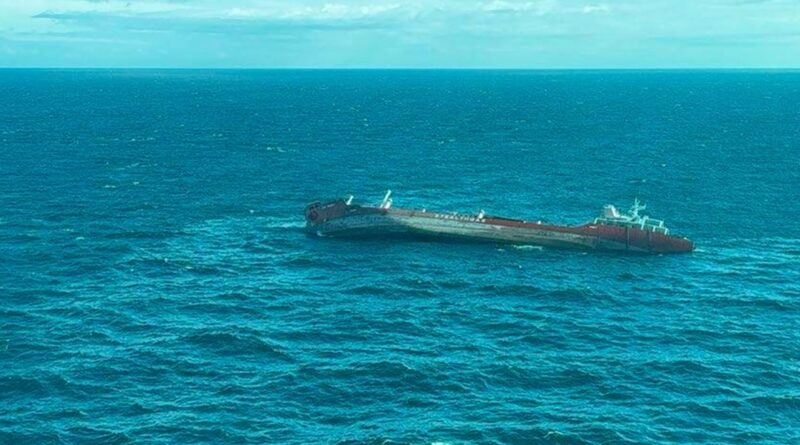
Romania’s Maritime Administration said that the November 17 sinking of the Gas Husky was the work of Russia, but Bulgaria’s authorities remained silent on the matter, as they have in all cases of the seven merchant ship attacks off Bulgaria’s Black Sea coast since the beginning of October.
Denkov said: “The ‘peace-making’ efforts of Radev and Yotova — which misled hundreds of thousands of Bulgarians during the elections — are yielding results. Just not the kind they promised”.
“In the Black Sea, two more ships have been sunk by Russian drone attacks in the span of just two days. We expect an explanation from ‘Prime Minister’ Radev as to when and exactly how peace will arrive, and when commercial vessels will once again be able to sail safely within our Black Sea economic zone,” Denkov said.
According to Denkov, Yotova must clarify whether her support for the resolution adopted at the 20th Summit of the International Organisation of La Francophonie — which identifies Russia as a military aggressor and reaffirms Ukraine’s territorial integrity within its internationally recognised borders — signals a shift in how the country’s leadership envisions the path to peace.
In a media statement on November 17, Democratic Bulgaria co-leader Ivailo Mirchev said: “We insist that President Yotova convene the Consultative Council of National Security”.
“There are two reasons. A seventh sunken ship, they still don’t know the reasons for the first sunken ship and who sank it. And secondly, Russia’s request, during the meetings in Abu Dhabi, to restore the geopolitical borders of 1997. If you remember, Bulgaria was not in Nato at that time,” Mirchev said.
Mirchev said that no measures have been taken since the first Consultative Council of National Security. That meeting was held on October 7.
“And not only that – when our allies provided us with a plane to monitor the Black Sea, what the authorities did was not give the order to destroy the drones that sank another ship. As a result, there are currently 421 containers on the Bulgarian coast,” Mirchev said.
Yordan Ivanov, a DB MP and chairperson of Parliament’s committee on transport and communications, said: “We from Democratic Bulgaria insist that the ruling party include in the agenda of the National Assembly this week our proposal for the creation of an interdepartmental unit under the Cabinet security council”.
“It should analyse the economic risks for the state budget and Bulgarian business arising from the crisis in the Black Sea. I recall that more than 20 years ago, a similar unit operated, which constantly assessed the risks to the economy related to difficulties in the transportation of goods. We insist that our proposal be considered this week,” Ivanov said.
The November 17 attack is yet another refutation of the statement by Deputy Prime Minister Ivo Hristov, who two weeks ago told Bulgarian National Television that after the end of the presidential elections, the attacks on the ships had stopped.
“We can note that the attacks stopped after the elections. We will definitely not hide the truth about the attacks, but throwing accusations at anyone could lead us to war,” Hristov – a former MEP who has a long record of pro-Russian statements – said.
The media statements by Bulgaria’s defence and transport ministries about the November 16 and 17 attacks emphasised how the sailors on the two vessels had been rescued. Nothing was said about who was behind the attacks, although it would take remarkable naïveté, incompetence or a yearning to play to a pro-Russian section of the electorate to blame any country other than Russia.
(Photo of the Gas Husky on November 17: Defence Ministry)


