
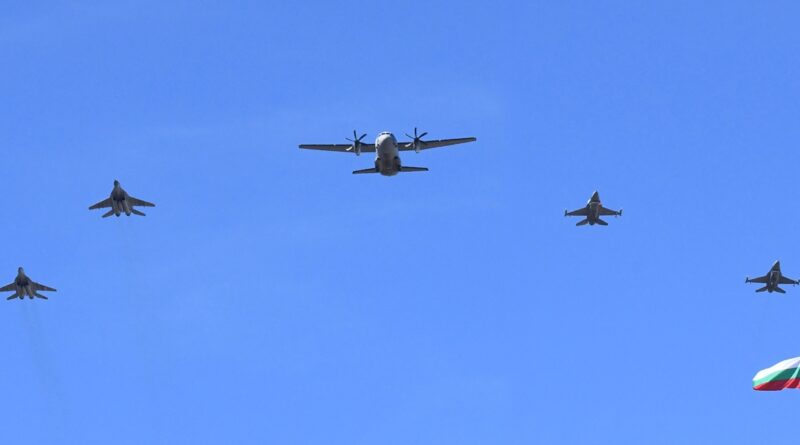
Defence Minister: MiG-29s and F-16s will guard Bulgaria’s skies ‘on rotational basis’ in 2027
Bulgarian skies will be guarded on a rotational basis by MiG-29s and F-16 fighter jets in 2027, Defence Minister Dimitar Stoyanov told a November 13 news conference about the defence budget for next year.
Stoyanov did not explain what is meant by rotation, but he said that in 2027, F-16s will only be on duty during the day because they are not certified and prepared for night flights.
He made it clear that the military will continue to rely on the nearly 40-year-old Soviet MiG-29 fighter jets, without it being clear how many of them are still operational, where spare parts will be obtained, and where they will be repaired and tested for safety.
At the same time, Stoyanov spoke of problems surrounding the use of the new US-made F-16 fighter jets. Bulgaria has already acquired eight of them and is waiting for another eight, which will probably arrive in Bulgaria in 2029, a delay from the initial schedule.
The first eight F-16s will also be modified. For example, they must be equipped with the new AN/ALQ-254(V)1 Viper Shield electronic warfare suite.
This is a mandatory electronic warfare package because it is related to the survival of the F-16 against modern radars and electronic threats. Stoyanov said that the US had given an assurance that the Viper Shield systems would be delivered and installed in 2027.
In addition, according to Stoyanov, the already trained Bulgarian pilots are prepared for air-to-air mode, not air-to-ground, that is, they cannot hit ground targets.
The repair of the engines, as well as the repair of maintenance units for the MiG-29 aircraft , is to be ensured.
“There is no way we can continue to fulfill our functional obligations, including our obligations to Nato structures, without the MiG-29 aircraft,” Stoyanov said.
There are also two new projects included in the new budget. They are related to the maintenance of the F-16. One is specifically for the maintenance of the F-16, and the second project is for the acquisition of additional missile armament for the aircraft.
As to when the F-16s can do duty fulltime, Stoyanov said that this could happen when the Viper Shield systems are received. But he added that the necessary pilots must also be available.
The draft budget of the Defence Ministry for 2027 envisages expenditures amounting to 2.23 per cent of gross domestic product.
The total planned finance for defence spending amounts to 3.151 billion euro, which is an increase of 17 per cent compared with 2026.
“The largest increase is in capital expenditures – from 868 million euro this year to over 1.223 billion euro next year,” Stoyanov said. This represents 40.83 per cent of the ministry’s budget budget.
“This is a budget for accelerated modernisation. With Nato’s requirement for a share of capital expenditures above 20 per cent, we exceed 40 per cent,” he said.
Stoyanov said that Bulgaria is working on many projects, both under the SAFE loan mechanism and from the Bulgarian budget.
This includes the acquisition of seven new three-coordinate (3D) radars , a coastal anti-ship missile system from the United States , French Caesar self-propelled artillery systems (SAU), German Iris ground-based air defence systems, 155 mm shells, vehicles, multiple launch rocket systems, drones.
The budget envisages purchasing six firefighting aircraft.
“We are working on the implementation of a project to acquire up to six firefighting aircraft. If the procedure passes without appeals, there is a possibility that the first two will be delivered by the end of 2027, after which the procedure for their absorption will begin,” Stoyanov said.
Stoyanov said that new projects will also be launched with national funds, including modernisation of the avionics of the C-27J Spartan transport aircraft and maintenance of the MiG-29.
It is also planned to acquire new small arms, unmanned aerial systems and space-based platforms; for reconnaissance and surveillance of land and sea targets, strike and FPV drones.
Personnel costs are maintained, with an additional four million euro to compensate for the increase in the minimum wage.
Military personnel will welcome the new year with frozen salaries, due to the freezing for the second time of the automatic increase tied to the average salary. ” If we increase salaries, we have to cut capital expenditures , ” Dimitar Stoyanov said recently.
To fill the shortage in the Bulgarian military, a target of 27.5 million euros from the central budget has been earmarked for the appointment of new military personnel.
At the same time, the resources saved from the dismissal of over 400 employees in the Ministry’s administration this year are being redirected to positions in the military formations.
Stoyanov hopes to recruit at least 1000 new military personnel in 2027, but he made it clear that he is not very optimistic.
The military itself admits that in some units there is even a 25 per cent shortage of personnel, with the situation being the worst in the army.
The Defence Ministry has tried to patch things up with initiatives such as “Be a Soldier” and with changes in the law to introduce so-called voluntary service, but in practice there has been little positive result and the personnel gap remains.
(Archive photo of Bulgarian Air Force Mig-29s, a Spartan and F-16s: Defence Ministry)