
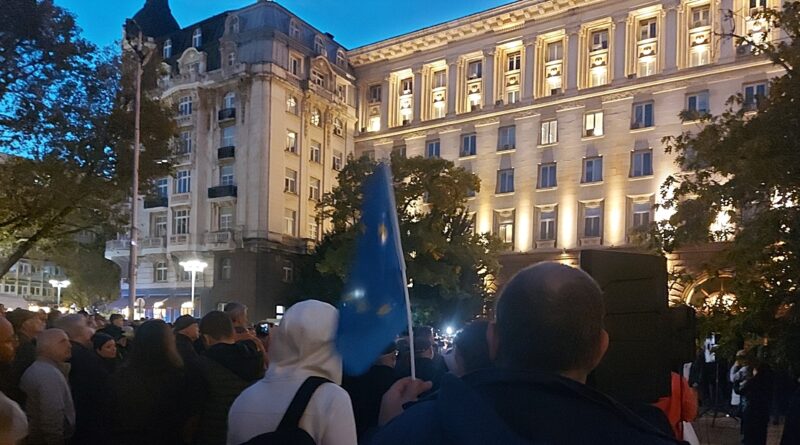
Large turnout in Bulgaria’s capital for protest against foreign policy of Radev and Yotova
There was a large turnout on the evening of October 20 outside the Presidency building in the centre of Sofia for a mass protest against the foreign policy of Prime Minister Roumen Radev and President Ilana Yotova.
The theme of the protest was “Your ‘peace’ is capitulation! Your ‘diplomacy’ is isolation!”.
The protest was organised online by public figures and former ministers and MPs and came after a succession of attacks on merchant ships in the Black Sea, for which Radev and Yotova have refused to lay blame on Russia as the culprit.
Hours before the protest, Radev reacted provocatively to the protest, saying that those behind it wanted to return Boiko Borissov and Delyan Peevski to power and saying that those involved in the protest were warmongers. “They want to push us to war,” Radev said.
Addressing the protest, journalist Georgi Angelov, whose programme on history was axed from the airwaves of public broadcaster Bulgarian National Television in a decision by its new management in August, said: “Without daring to name who is the aggressor and who is the warmonger, they call us warmongers. Who is the warmonger? Russia”.
“What is this flirtation with (Russian ambassador) Mitrofanova, what is this flirtation with China?” Angelov said.
Angelov also criticised the state of Bulgarian journalism, highlighting self-censorship, fear, and the insufficient professional training of some journalists.
He made a distinction between today’s media environment and censorship during the communist regime, but emphasised that freedom of speech does not exclude the existence of unspoken pressure and self-restraint.
“I call this self-censorship. Either they are not telling the truth, or they do not dare to tell the truth, or they do not know the truth,” Angelov said.
Speakers accused Radev and Yotova of behaving like “national traitors” in their actions over the attacks, and insisted that all available information so far pointed to Russia as the culprit.
Iliyan Vassilev, a former ambassador to Moscow, said: “Never in the history of the transition has there been a more militarised government. There are generals there, there are colonels there, in general, the entire military prowess of the nation”.
“And it is precisely this government that is unable to protect us because it refuses to call things by their real names. And the problem is even more serious because, being internally unfree, dependent, they are afraid to even ask for the full amount of help that they can receive from our allies,” Vassilev said.
“And do you know why? Because they are afraid that Russia will see in this request for help a reason to think that it is getting us into war. Can you imagine how absurd it is? Things have reached the point that they are afraid that we will build a defence potential and, since we do not have our own, ask our partners to provide it for us,” he said.
Historian Stefan Dechev cited several examples of relations between Bulgaria and Russia, emphasising the need for Bulgaria to defend its independence and national interests.
“June 22 1941 Hitler attacked the Soviet Union. Soviet bombs were dropped by aviation on Dobrich, Gorna Oryahovitsa, Rousse and elsewhere,” Dechev said.
“We maintain diplomatic relations with Soviet Russia. Without asking, without checking and without having meetings, the Bulgarian government sent a protest note to Moscow. What was Moscow’s response? The planes were not Soviet, but either Romanian or German,” he said.
Economist Evgeni Kanev said: “Ships refuse to enter our ports. We cannot export our production. Romania wants decisive Nato intervention. What are we doing? Our hope is in ourselves. We must save the state. We have already done it when the state was on its knees, when the kneeling Yotova was kissing the hand of the patriarch. Not the Bulgarian one, the Russian one”.
Kanev was referring to a March 2018 incident in which, when Kirill – the Russian Patriarch and close ally of Putin – arrived at Sofia Airport for an official visit and then-vice president Yotova fell to her knees in front of him.
In the course of the speeches, there were boos and catcalls at references to Radev, Yotova and Defence Minister Dimitar Stoyanov, with chants calling on them to resign.
The protest came five days ahead of Bulgaria’s regular presidential elections, in which Yotova, who took over the post of president in January 2026 when Radev stepped down to enter parliamentary politics, is seeking election in her own right as head of state.
(Photo: Clive Leviev-Sawyer)


