
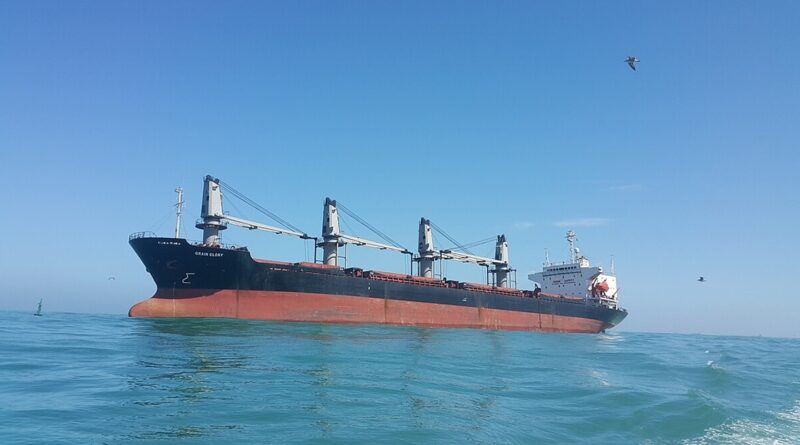
Bulgarian grain producers association: Ships have already refused to come to our ports for grain exports
Ships have already refused to come to Bulgaria’s ports for grain exports, and Bulgaria has five million tons of wheat to export, Iliya Prodanov, chairman of the National Association of Grain Producers, told Bulgarian National Television (BNT) on October 16.
In the past few days, four merchant ships have been hit in Bulgaria’s exclusive economic zone in the Black Sea, with two vessels sunk with loss of life, and two have been hit in Romania’s territorial waters.
“The situation is very dynamic,” Prodanov said.
“Maybe a few days ago…I would have said that we have no problem with the export of Bulgarian grain. However, since yesterday, the situation has been radically different,” he said.
“We already have ships that have refused to come to Bulgarian ports,” Prodanov said.
Others are simply delaying their arrival and are standing in the southern part of the Black Sea, he told BNT.
This is starting to escalate as a problem and the Black Sea is really starting to become dangerous for wheat exports, and Black Sea wheat is key to the world grain balance, he said.
Prodanov said that world production of wheat is about 800 million tons. Of these, however, only 200 million tons are the subject of real trade, he said. Everything else is retained in the countries that produce it and is consumed there, he said.
“That is, 200 million tons is the entire volume of international wheat trade. Of these, 50 million tons are from Russia, 20 million from Ukraine, approximately 10 million from Romania, “five million — from Bulgaria and 10 million — from Kazakhstan. There are years when almost 50 per cent of the world’s wheat trade comes from our Black Sea region.”
The transitional remnants of last year’s harvest have already been realised, Prodanov said.
“Bulgaria had transitional residues that it managed to export in July and after the end of the harvest. Maybe from August we started exporting the new harvest. If the situation does not normalize and the ships do not start coming normally, there is a risk that Bulgaria will not be able to export the available wheat.”
Insurance has become more expensive, Prodanov said. Since the beginning of the war in Ukraine, the price of grain transportation from the Black Sea basin has jumped five to six times, he said.
Prodanov said that Bulgaria must urgently guarantee the safety of shipping in the Black Sea.
“Bulgaria must somehow guarantee that its territorial waters are safe so that Bulgarian ports can remain attractive to ships, as they were a few days ago,” he said. “Otherwise, we will certainly lose markets.”
The question here is who will replace these markets, because if there is nowhere for this wheat to come from, the problem becomes international, he said.
There will be a shortage of wheat. The price of wheat on world markets may increase, but in the Black Sea basin the exact opposite will happen because the wheat remains here and we cannot sell it on the domestic market, he said.
There are no alternative options for exporting grain from Bulgaria, except via ships, Prodanov emphasized.
“This is exactly the biggest problem. Bulgaria has no alternative to its Black Sea ports. Since 2021, the European Commission has been approaching this issue and talking about the need to create alternative routes to Greek ports – both from Romania and Bulgaria.”
Bulgaria needs to export five million tons of wheat, Prodanov said.
“The only option is rail transport. However, our rail connectivity with Greece is at a miserable level. There are only one or two places where the border can be crossed. The infrastructure there is simply in a terrible state,” he said.
At the moment, Bulgaria does not have the necessary infrastructure to export these quantities of grain by rail. “That is why I say that we have no alternative.”
“Here we must divide the situation into two,” Prodanov said.
“First, Bulgaria must find a short-term solution for the safety of shipping to our ports so that we can export. And second, we must work long-term, so that if a similar problem arises again in the future, Bulgaria has guaranteed its ability to export through Greece. Because otherwise our hands are simply tied. Bulgaria has no other option.”
Bulgaria consumes about 1.2–1.3 million tons of wheat.
“The rest will accumulate as a surplus. If we do not export through the Black Sea ports — something that I do not even want to imagine is possible at the moment — Bulgaria will welcome the new harvest with huge transitional residues,” he said.
“This will have a detrimental effect on both the price and the ability to store this wheat. The point is that there are not enough warehouses in which to store the production of two harvests. Bulgaria does not only produce wheat. We have sunflower, corn, barley…” Prodanov said.
(Photo: Farid mernissi, via Wikimedia Commons)