
Polish air defences on high alert after suspected Russian ballistic missile falls in eastern Poland
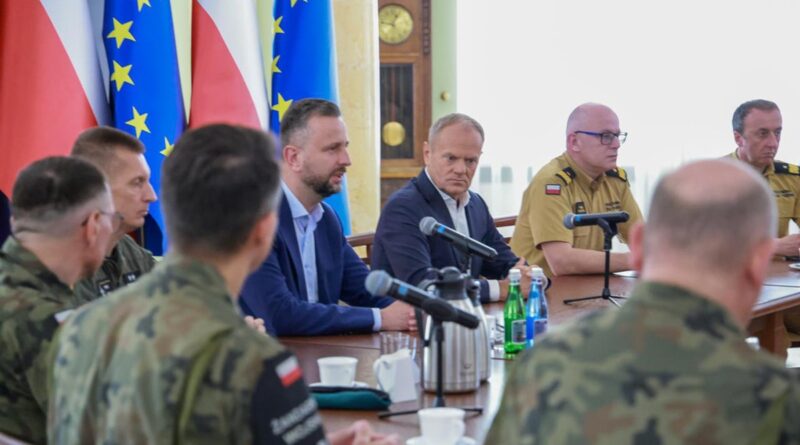
Polish air defence systems are on high alert after what was suspected to be a Russian ballistic missile fell in eastern Poland on July 29, Minister of National Defence Władysław Kosiniak-Kamysz told a coordination team meeting, his ministry said.
The BBC reported that the unidentified object caused a 10m-wide crater a short distance from the village of Tarnawa Kolonia, about 100km from the border with Ukraine during a Russian attack on the city of Lviv.
Poland’s Prime Minister Donald Tusk, who convened the July 30 meeting, said on X that he was in contact with the leaders of European countries regarding the violation of Polish airspace.
“Everyone declares full solidarity and readiness for any assistance,” Tusk said.
The Ministry of National Defence said that Kosiniak-Kamysz presented the meeting in detail with the course of the night operational activities and the scope of the deployed Polish and Allied forces.
These resources include Polish F-16 duty aircraft, which had been operating near the Polish-Ukrainian border since around 2am, awaiting further orders.
Additionally, reconnaissance aircraft were deployed, operating over Polish airspace, and allied air-to-air refueling aircraft, which took off from the Federal Republic of Germany and operated over Polish territory, he said.
Kosiniak-Kamysz said that operational activities related to the identification of the object at the scene are currently underway.
“Pyrotechnic analyses are being conducted to locate all elements of the object, as well as to determine the exact type of object we are dealing with,” he said.
“Pyrotechnic analyses are being conducted to locate all elements of the object, as well as to determine the exact type of object we are dealing with.”
Kosiniak-Kamysz said that the hypothesis presented by Tusk, that it is a Kh-101 missile, of the dozens fired that night over Ukrainian territory, “is currently the most probable”.
“Of course, it must be confirmed. All activities related to the operation of our and allied aircraft are also coordinated with the Nato Joint Force Command. Nato commanders are being kept informed,” Kosiniak-Kamysz said.
“We will be providing a comprehensive report. All the highest state authorities – the Prime Minister and the President – are also receiving ongoing reports from all state services.”
Kosiniak-Kamysz drew attention to the change in the vector of Russian attacks and the proximity of combat operations at the Polish border.
“This was one of the largest attacks on western Ukraine. In recent months, attacks have been directed more towards Kyiv, its surroundings, and the eastern part of Ukraine,” he said.
This attack was also launched against western Ukraine, Kosiniak-Kamysz said.
“The situation we observed on Ukrainian territory initially involved over 20 objects located close to Polish airspace. MiG-29 fighter jets of the Ukrainian Armed Forces also operated very close to Polish airspace. This also involves coordinating actions with the Ukrainian side and sharing information,” he said.
(Photo: Poland’s Ministry of National Defence)