
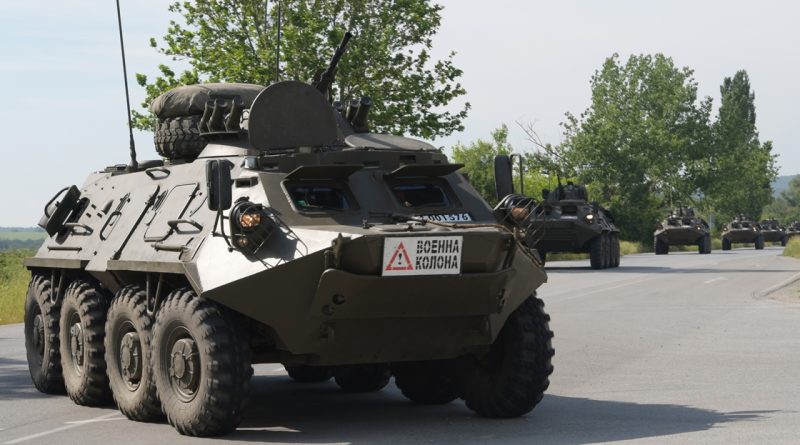
European Parliament backs ‘military Schengen’ to help withstand potential Russian aggression
Members of the European Parliament voted on December 17 to approve a resolution calling for the removal of internal borders for the movement of troops and military equipment across the EU, and for upgrades to railways, roads, tunnels and bridges.
The resolution on military mobility was adopted by 493 votes to 127, and with 38 abstentions,
Russia’s war against Ukraine has drawn renewed attention to military mobility and the urgent need to facilitate the rapid cross-border movement of troops, equipment and assets across Europe, say MEPs.
They emphasise that military mobility is an essential enabler for common European security and defence, but also crucial for the security of the eastern flank, in particular the Baltic countries and Poland.
The European Parliament’s resolution welcomes the European Commission’s proposal to raise the military mobility budget in the next long-term budget to more than 17 billion euro.
MEPs call on EU countries to refrain from making cuts to this proposal, as they did in the 2021-2027 budget when they cut proposed funds by 75 per cent.
Upgrading 500 infrastructure “hotspots”, such as bridges or tunnels, would require at least 100 billion euro, they add, urging the Commission to simplify the procedures for obtaining funding for dual-use projects.
The European Parliament acknowledges that although significant progress has been made to enhance military mobility, there are still considerable administrative and financial barriers, as well as infrastructure obstacles, which means that it can sometimes take over a month to move military equipment across the EU.
MEPs call on EU countries and the European Commission to invest more in transport infrastructure, especially along the four EU military mobility corridors. They also want to see more digital solutions applied, and cross-border movement authorisations accelerated by means of a one-stop-shop.
They recommend working towards a “military Schengen area”, reinforced by a military mobility task force and a European coordinator to streamline implementation of the different initiatives, with the Commission providing a roadmap.
The European Parliament emphasises that military mobility is a priority for EU-Nato co-operation and essential to enable the movement of allied forces in times of peace, crisis or war.
The resolution calls for regular joint exercises and stress tests to identify and remove obstacles.
MEPs also want the EU to follow Nato’s example and ensure rapid reaction troops could cross internal EU borders within three days in “peacetime” and within 24 hours in a crisis situation.
(Photo: Bulgaria’s Ministry of Defence)


