
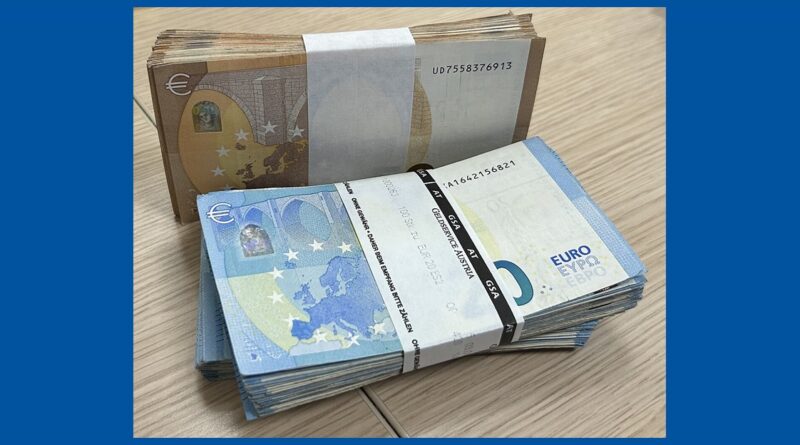
Eurobarometer poll finds strong support for euro in the 20 euro zone countries
The latest Flash Eurobarometer survey, the results of which were released on December 5, has found that 79 per cent of respondents in the 20-member euro zone believe that having the euro is a good thing for the EU.
This is consistent with the findings of a similar poll in 2024, the European Commission (EC) said, reporting the results of the poll.
Thirteen per cent think the euro is a bad thing for the EU, while four per cent spontaneously said that they could not decide whether the euro is a good or a bad thing for the EU.
The poll did not include Bulgaria, which will become the 21st member of the euro zone on January 1 2026.
A large majority of 70 per cent of respondents in the euro zone also believe it is a good thing for their own country.
Although a majority of respondents support the euro in all 20 euro-area countries, that is, they think the euro is a good thing for the EU, the level of support differs significantly across countries.
Support for the euro is highest in Finland, where 91 per cent of respondents say that having the euro is a good thing for the EU.
Finland is followed by Lithuania, Slovenia and Slovakia, where 85 per cent say the euro is good for the EU, and Germany and Estonia, where 84 per cent say so. The lowest support is observed in Croatia (67 per cent).
Compared to the results from October 2024, support for the euro has significantly decreased in Croatia (-7 pp, to 67 per cent), Belgium (-5 pp, to 77 per cent), Ireland (-4 pp, to 79 per cent), Spain (-4 pp, to 78 per cent) and Slovakia (-4 pp, to 85 per cent).
A majority of euro-area respondents (54 per cent) say that the euro has made travelling easier and less costly, compared to 39 per cent who said that travelling is not easier or less costly since the introduction of the euro.
Fewer than one in 10 (seven per cent) said that they did not know whether the euro had made travelling easier and less costly.
Close to half of respondents (48 per cent) think the euro has reduced banking charges when travelling in different EU countries, while 32 per cent think the euro has had no impact on banking charges. One in five (20 per cent) are unable to form an opinion on this matter.
Compared with October 2024, opinions on these practical benefits of the euro have remained stable, with no significant change in the proportions who think the euro has made travelling easier and less costly or who believe it reduced banking charges when travelling.
Around eight in 10 respondents (81 per cent) believe the euro has made it easier to compare prices and shop in different countries, including online, while 13 per cent hold the opposite view and 6 per cent say they do not know.
When asked whether the euro has made doing business in different EU countries easier, 79 per cent agree, while 11 per cent hold the opposite view and 10 per cent say that they do not know whether the euro has made doing business in the EU easier or not. The results for these two items are consistent with those observed in October 2024.
In January 2023, the euro currency was introduced in Croatia. The last section of the report looks at Croatia and its citizens’ views on the euro.
Almost all those surveyed in Croatia say that euro banknotes are easy to distinguish and handle when making cash payments: 54 per cent find it ‘very easy’ and 33 per cent ‘rather easy’.
About one in 10 respondents answer that they find it ‘rather’ (seven per cent) or ‘very difficult’ (two per cent) to distinguish and handle euro banknotes.
When asked how easy they find it is to distinguish and handle euro coins when they make cash payments, 37 per cent of respondents in Croatia find it ‘very easy’ and 28 per cent ‘rather easy’.
Respondents in Croatia who said they find it difficult to distinguish and handle euro coins when paying cash – around 30 per cent of all those surveyed – were asked with which euro coins they have difficulties. Most of these respondents experience particular difficulties with lower denomination coins rather than with higher value euro coins.
More than three-quarters of these respondents have particular difficulties with the 1-cent coin and with the 2-cent coin (77 per cent each).
Approximately two-thirds (67 per cent) consider the 5-cent coin difficult to distinguish and handle; 48 per cent think the same about the 10-cent coin, 43 per cent about the 20-cent coin and 24 per cent about the 50-cent coin. For each of the higher denominations, less than one in 10 respondents have difficulties.
In Croatia, 59 per cent of respondents still convert from the price in euro to the Croatian kuna when buying things. By comparison, 39 per cent say they do not make such conversion. These figures have remained stable compared to October 2024.
Among those still converting to their old currency, 50 per cent do so for common purchases such as day-to-day shopping. In contrast, nine per cent do so only for exceptional purchases such as the purchase of a car or a house.
Respondents in Croatia were asked whether they think that the introduction of the euro had an impact on prices during the changeover period.
More than eight in 10 respondents (84 per cent) think that all prices increased, while a much smaller share (12 per cent) say that prices increased in only some categories. Only three per cent say that prices have more or less stayed the same. These results are consistent with those from October 2024.
(Photo: BrayLockBoy, via Wikimedia Commons)