
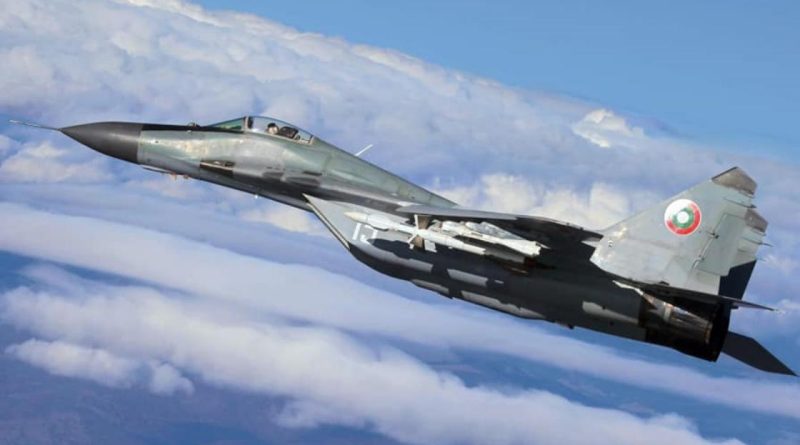
Bulgarian Air Force chief: Black Sea patrols to continue as long as necessary
The increased patrolling over the Black Sea is a preventive measure due to the situation in the war north of Bulgaria and will continue as long as necessary, Bulgarian Air Force commander Major General Nikolai Rusev told Bulgarian National Television (BNT) on October 23.
Various types of military aircraft have been deployed in recent days in response to attacks on merchant ships in the Black Sea off the coasts of Bulgaria and Romania, with the attacks widely seen as the work of Russia, though Bulgaria’s Roumen Radev government has declined to apportion blame.
Rusev told BNT that Bulgaria has people and aircraft prepared to carry out the tasks, but radar coverage has limitations, especially for low-flying objects.
“You, the media, are the ones who constantly inform us of what is happening north of us and we all see that the situation is not easy at all,” Rusev said.
“People are dying. Bulgarian skies are protected, but we still have to take some preventive measures to prevent something like this from happening down south towards Bulgaria, towards our sea and in our airspace,” he said.
Rusev said that the increased flights are not an isolated initiative by the Air Force, but part of joint activities by the various branches of the armed forces.
“The measures we have taken are preventive. Our planes are flying. Every plane, every fighter, every attack aircraft can affect a certain object in a different way,” Rusev said.
“That is why we have taken this thing, and this is not an accidental action of only the Air Force,” he said.
“These are coordinated actions, thoughtful actions of the different types of armed forces. We work together, we interact, so the ground forces are also involved in this thing, and the Navy, and the Special Forces. Everyone has their own task, everyone fulfills it, but we are pursuing the same result, the same goal.”
Asked how long the military can maintain the increased patrolling, Rusev gave an assurance that it has the necessary aircraft and pilots.
“We will maintain it as long as it is necessary. We have enough planes for this thing, with resources, we have pilots, so that is our job. If necessary, we carry out this task for as long as necessary.”
In addition to the aircraft in the air, Bulgaria has deployed additional surveillance systems. Information about the air situation is also received from neighbouring countries, Rusev said.
“So we are in constant contact and have the full picture of what is happening in the airspace. Not only over Bulgaria, but also over the Balkan Peninsula and in the waters of the Black Sea.”
Rusev said that the task of the fighter jets is not limited to surveillance. They must be ready to react if necessary.
Coordination between aircraft, radars and anti-aircraft missile systems in the Air Force is carried out within the framework of the common control system. Communication channels have also been established with the other types of armed forces, Rusev said.
“It is important what kind of equipment we have and that we know how to operate it. It is also important to have trained people to operate these techniques.”
“We have prepared people. I say this quite responsibly. Everyone knows the equipment we have. In terms of aviation – MiG-29, F-16, Su-25, L-39. These are the aircraft that can be used for combat use and participate in airspace protection..”
Regarding radar coverage, Rusev admitted that the radars currently in use are more than 30 years old. They are maintained in good condition, and the information they receive is supplemented by data from allies and neighbouring countries.
Bulgaria has already signed a contract for the acquisition of new radars. According to Rusev, the first system should arrive in the country within about a year and a half. In parallel, work is also underway to acquire new anti-aircraft missile systems.
“But with the new radars that we will acquire, I can say right now that a contract has already been signed for new radars, within a year and a half the first radar will be in Bulgaria. It is also a matter of time before a contract is signed for the new anti-aircraft missile systems. That is, the Air Force, the Defence Headquarters, the Ministry of Defence are actively working on it. We have not stopped.”
When asked whether radars can detect low-flying drones and Geran-type jet-powered unmanned aerial vehicles, Rusev said it depends on the height of the target. He said that the military also detects objects that are not publicly reported.
“It depends on the height of the target, certainly on the radar you can see this target. We see a lot of things that we don’t announce because there’s no need to scare people and it’s not worth them being scared about this thing. But our job is to monitor the airspace and if necessary, to act.”
Rusev also commented on the presence of the US Navy Poseidon P-80 reconnaissance and maritime patrol aircraft in Bulgaria. Hesaid that the aircraft will remain for an extended period to carry out its assigned tasks, and emphasized that it is not the only Allied asset assisting the Bulgarian military.