
Bulgaria’s Parliament doubles fines for individuals and companies breaking tax laws
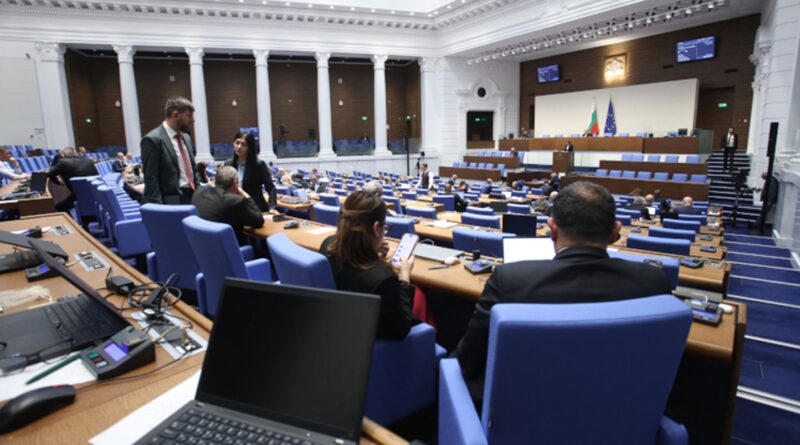
With the backing solely of Prime Minister Roumen Radev’s Progressive Bulgaria party, Parliament approved on November 26 the second and final reading of amendments to the Personal Income Tax that double the fines for tax law violations by individuals and companies.
This sparked fierce criticism from the opposition.
In amendments, all currently existing fines that are still written in leva are directly replaced with euro, with their numerical value being preserved, without respecting the principle of currency conversion at the fixed exchange rate.
For example, failure to file an annual tax return within the legal deadline will now be punished with 500 euro, compared to the previous penalty of 500 leva. If the fixed exchange rate were applied, the fine would be 255.65 euro, not twice as high.
For filing a tax return with false content, the current fine of 1000 leva is proposed to become 1000 euro next year. Employers who do not withhold and remit the tax to the budget will also be punished with a double penalty – the current 1000 leva will become 1000 euro, and in the event of a repeated violation, it will jump from 2000 leva to 2000 euro.
Martin Dimitrov of opposition Democratic Bulgaria said that if firms in the private sector took the same approach, they would be severely fined.
“And what are your motives for making a 500 leva fine instead of 500 euro?” Dimitrov said.
Assen Vassilev of opposition We Continue the Change said: “This is a very bad parliamentary practice – you make raises without motivation. When you wonder why inflation is high, remember this example”.
Alexander Ivanov of GERB-UDF accused the government of violating the Euro Adoption Act, which says that the conversion of prices and fees can only be at the rate of 1 euro for 1.95583 leva.
Milen Trifonov of Progressive Bulgaria said that some fines have not been changed for two decades and have lost their disciplinary character.
“For example, how would a person with huge incomes be motivated to file an annual tax return if he knows that he will be sanctioned with only 500 leva. Such a sanction does not work preventively,” Trifonov said.
However, Trifonov refrained from explaining that failure to declare large incomes, leading to large-scale tax evasion, entails quite severe sanctions, forced collection by the National Revenue Agency, and criminal liability under the Criminal Code.
He said that in many cases, tax laws only specify maximum fines, and this is to the benefit of taxpayers. “Tax inspectors have a proven practice of assessing what fine to impose based on the severity of the violation. For minor violations, they will impose low fines, not the maximum ones,” Trifonov said.
The ruling party rejected all the opposition’s proposals for strict adherence to the fixed exchange rate when converting fines from leva to euro. The DB’s proposal to increase the tax discount for early filing of a tax return and payment of the full amount of tax from 500 leva to 500 euro was also rejected. Instead, the correct conversion is applied here – 255 euro.
The majority of the other amendments to the Personal Income Tax Act were voted on with full support from all parties. These include an almost 70 per cent increase in tax rebates for children up to 500 euro for one child, 1000 euro for children and 1500 euro for three or more children, and a 1200 euro tax credit for a child who has a disability.
(Photo: parliament.bg)


